Digital Paddle Wheel Water Flow Meters
Overview of Paddle Wheel Meters
Paddle Wheel Flow Meter Overview
Paddle Wheel Flow Meter - Function and Applications
The paddle wheel meter is a dependable and simple instrument for measuring liquid flow in pipes and has found wide usage in various applications. However, paddle wheel meters are not recommended for all applications. Certain conditions are not advisable; see more below.
Applications
Paddle wheel flow meters are dependable, versatile devices used in a multitude of fields and industries to measure the flow rate of liquids. They are dependable, low cost, effective, and easy to use.
- Water and wastewater treatment: Monitor the flow of water and treatment chemicals, ensuring proper dosing and efficient operation.
- Food and beverage industry: Oversee the flow of ingredients, cleaning solutions, and products during processing to maintain consistent quality and hygiene standards
- HVAC systems: Incorporated into heating, ventilation, and air conditioning systems to measure water flow in cooling and heating applications, optimizing energy consumption and system performance.
- Irrigation and agriculture: Manage water flow in irrigation systems.
- Pulp and paper industry: Used to control the flow of water and other fluids during the paper-making process.
- Metal and mining operations: Utilized for monitoring the flow of liquids, such as coolants and other processing fluids, within metal and mining processes.
- Marine and boating: Implemented in marine applications to measure the flow of cooling water and ballast water.
Design
A paddle wheel flow meter features a straightforward design optimized for measuring fluid flow rate within a pipe. Central to this design is the paddle wheel, consisting of blades or paddles affixed to a central hub. The wheel is positioned perpendicular to the flow, allowing the fluid to pass through and turn the paddles as it flows.
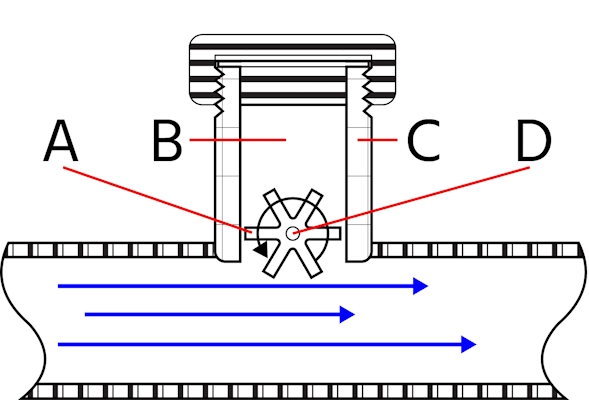
Components of paddle wheel flow meters include:
- Paddle wheel (A): The paddle wheel is the only moving component, it freely rotates proportional to the speed of the water flow. The paddle wheel is supported by water lubricated bearings that operate with minimal friction and wear.
- Sensor (B): The sensor is a magnetic reed switch that detects the paddle rotation. As the magnet contained in the paddle passes by the sensor it creates an electrical pulse which the microcontroller utilizes to calculate the flow rate and also update the totalizer registers.
- Housing (C): The paddle wheel and sensor are contained in a PVC machined adapter. PVC is ideal for normal water applications.
- Flow rate calculation: A low power microcontroller processes the pulse train coming from the paddle wheel sensor and calculates the flow rate and updates the totalizers.
- Output display: The calculated flow rate can be displayed in either Gallons or Liters units of measurement, depending on the system's requirements, and can be transmitted to control systems for further processing or recorded for monitoring purposes.
Paddle wheel flow meter working principle
The paddle wheel is positioned within the flow stream. As water passes through the meter, the following occurs:
- Water interaction: The flowing water directly engages with the paddle's fins. The force of the fluid's movement against the paddle blades imparts rotational energy to the wheel.
- Proportional rotation: The speed at which the paddle wheel spins is directly proportional to the velocity of the flowing water. A faster flow rate results in a higher rotational speed of the paddle wheel and vice versa.
- Sensing mechanism: Near the paddle, in one of the support legs, is a magnetic sensor. The paddle contains magnets that generate pulses each time they pass by the sensor.
- Flow rate calculation: The microcontroller(a form of small computer) interprets the frequency of the generated electrical signals and calculates the flow rate. The number of pulses over a given time indicates the volume of fluid that has passed through the meter.
- LCD display: The calculated flow rate, an 8 digit resettable totalizer and an 8 digit non-resettable totalizer are displayed in either Gallons or Liters.
Paddle wheel flow meter advantages and disadvantages
Advantages
- Cost-effective: One of the main benefits of paddle wheel flow meters is their affordability.
- Easy installation/maintain: Paddle wheel meters are simple to install. Maintenance typically involves cleaning and occasionally replacing the paddle wheel and pin.
- Good accuracy for the price: Accuracy is good at a lower price point compared to many other technologies.
Disadvantages
- Flow profile: Paddle wheel flow meters require a fully developed flow profile for accurate measurements. Typically straight runs of pipe are required upstream and downstream of the meter.
- Wear: The moving parts(paddle and pin) will wear over time and require replacement.
- Limited to small particulate loading: Large solids in the water stream can clog/obstruct or damage the paddle.
- High-viscosity fluids: The increased resistance will prevent the paddle wheel from turning freely.
Selection criteria
Choosing the right paddle wheel flow meter involves consideration of several factors to ensure accurate measurements and long-term reliability. The following criteria are essential when selecting a paddle wheel flow meter for a particular application:
- Fluid characteristics: The type of liquid being measured greatly influences the choice of a paddle wheel flow meter. The fluid should be clean and low-viscosity to prevent damage to the paddle wheel and ensure it can rotate freely. Additionally, the chemical compatibility of the fluid with the flow meter's materials must be confirmed to prevent corrosion or degradation.
- Flow rate range: Each pipe size has a specified flow rate range within which it can accurately measure. Selecting the proper pipe is essentail. Trying to measure flow rates below the recommended range will result in inaccurate results.
- Pipe size and installation: The size and configuration of the existing piping play a critical role in paddle wheel flow meter selection. The meter must fit the pipe diameter and be compatible with the piping material. It's also important to ensure that there's enough straight pipe run before and after the meter to establish a stable flow profile.
- Process conditions: The operating pressure and temperature of the process should be within the paddle wheel flow meter's specifications. Exceeding these limits can result in damage to the flow meter or inaccurate readings.
- Accuracy requirements: Assess the level of accuracy needed for the application. Paddle wheel flow meters typically offer good accuracy, but if the application requires precision, verify that the selected meter meets these requirements.
- Installation environment: Consider the environment where the flow meter will be installed. Factors such as exposure to the elements, potential for impact or interference, and accessibility for maintenance should influence the selection.
- Regulatory and safety considerations: In certain industries, there may be regulations or standards that dictate the type of flow meter that must be used. Safety considerations, such as the need for explosion-proof ratings in hazardous environments, should also be taken into account.
- Maintenance and lifespan: Paddle wheel meters have one moving part that will wear over time, consider parts availability when choosing a meter company.
A paddle wheel flow meter is a device used to measure the flow rate of liquids in a pipeline by utilizing a rotating paddle wheel mechanism. It is commonly employed in various industries, including water treatment, chemical processing, irrigation, and HVAC systems, due to its simplicity, cost-effectiveness, and easy installation process.
Introduction to Paddle Wheel Flow Meter
A paddle wheel flow meter consists of a rotor with blades (paddles) mounted inside a pipe or flow channel. As the liquid flows through the pipe, it causes the paddle wheel to rotate. The rotational speed of the paddle wheel is proportional to the flow rate of the liquid. Sensors, typically magnetic or optical, detect the rotation and convert it into an electrical signal, which is then processed to calculate the flow rate. The output is usually displayed in units such as liters per minute (LPM) or gallons per minute (GPM).
Key Components:
- Paddle Wheel/Rotor: The rotating element with blades that spins as fluid flows past it.
- Sensor: Detects the rotation of the paddle wheel (e.g., Hall-effect sensor for magnetic detection or optical sensor).
- Housing: The body of the meter, typically made of materials like stainless steel, PVC, or brass, chosen based on the fluid's properties.
- Electronics/Display: Processes the sensor signal and provides flow rate data, often with options for analog or digital outputs.
Working Principle: The paddle wheel flow meter operates on the principle of fluid dynamics. The velocity of the liquid flowing through the pipe imparts kinetic energy to the paddle wheel, causing it to rotate. The frequency of rotation is directly proportional to the flow velocity, and since the pipe's cross-sectional area is known, the volumetric flow rate can be calculated using the formula:
Flow Rate (Q) = Velocity (v) × Cross-sectional Area (A)
The sensor detects the rotations (e.g., via magnets embedded in the paddle wheel) and generates a pulse or signal that is translated into a flow rate by the meter's electronics.
Usage of Paddle Wheel Flow Meters
Paddle wheel flow meters are versatile and widely used in applications requiring accurate flow measurement of liquids. They are particularly suited for clean or slightly contaminated liquids, such as water, chemicals, or low-viscosity fluids.
Applications:
- Water Management:
- Monitoring water flow in water distribution systems.
- Measuring flow in irrigation systems for agriculture.
- Water treatment plants for dosing chemicals or monitoring treated water.
- Industrial Processes:
- Measuring flow in chemical processing for precise fluid control.
- Monitoring coolant flow in HVAC systems or industrial cooling towers.
- Batch processing in food and beverage production.
- Energy and Utilities:
- Measuring flow in boiler feedwater systems.
- Monitoring coolant in circulating loops.
- Environmental Monitoring:
- Measuring flow in wastewater treatment systems.
- Monitoring discharge in environmental compliance systems.
- Collect data for state/federal government agencies.
Advantages:
- Cost-Effective: Relatively inexpensive compared to other flow meter types (e.g., ultrasonic or Coriolis).
- Simple Design: Easy to install and maintain, with few moving parts.
- Wide Range of Applications: Suitable for various pipe sizes and fluid types.
- High Accuracy: Provides reliable measurements for clean liquids, typically within ±1-2% accuracy.
- Low Pressure Drop: Minimal impact on system pressure, making it suitable for low-pressure systems.
Limitations:
- Fluid Compatibility: Not ideal for highly viscous fluids, slurries, or liquids with suspended solids, as these can damage the paddle wheel or affect accuracy.
- Installation Sensitivity: Requires a straight pipe run (typically 10 pipe diameters upstream and 5 downstream) to ensure accurate measurements.
- Limited to Liquids: Not suitable for gas flow measurement.
Installation and Usage Guidelines:
- Proper Positioning:
- Install the meter in a straight section of pipe to avoid turbulence, which can affect accuracy.
- Ensure the paddle wheel is fully submerged in the liquid and oriented correctly (per manufacturer’s instructions).
- Fluid Compatibility:
- Select a meter with materials compatible with the fluid (e.g., stainless steel for corrosive liquids, PVC for water).
- Avoid fluids with high particulate content unless the meter is designed for such conditions.
- Calibration:
- Calibrate the meter for the specific fluid and flow range to ensure accuracy.
- Regular maintenance and cleaning are necessary to prevent fouling or wear.
- Electrical Connections:
- Connect the meter’s output (e.g., 4-20 mA, pulse, or digital) to a control system or display unit as needed.
- Ensure proper grounding to avoid electrical interference with sensors.
- Flow Range:
- Choose a meter suited for the expected flow range, as paddle wheel meters have minimum and maximum flow thresholds for accurate measurement.
Typical Specifications:
- Flow Range: 0.1 to 10 m/s (varies by model).
- Pipe Sizes: ½ inch to over 24 inches.
- Materials: PVC, polypropylene, stainless steel, or brass.
- Output Types: Pulse, 4-20 mA, Modbus, or digital displays.
- Operating Temperature: Typically -10°C to 80°C (higher for metal models).
- Pressure Rating: Up to 150 psi for plastic models, higher for metal.
Maintenance:
- Regularly inspect the paddle wheel for wear or debris buildup.
- Clean the meter to prevent fouling, especially in applications with dirty fluids.
- Check sensor functionality and recalibrate periodically to maintain accuracy.
Conclusion
Paddle wheel flow meters are a reliable and economical choice for measuring liquid flow in various applications, particularly where clean fluids are involved. Their ease of use, affordability, and versatility make them popular in industries ranging from water management to chemical processing. However, proper selection, installation, and maintenance are critical to ensuring accurate and long-lasting performance.
If you need specific details about paddle wheel flow meters (e.g., model selection, troubleshooting, or comparisons with other flow meters), let me know, and I can dive deeper or search for real-time information if required!